DC, the "old"
technology
According to the old archived information at www.electrotherapymuseum.com
Direct Current treatment of tumors and infections was the most common
method used by doctors between 1900 and 1930 before chemical medicines
became the new medical fad. I have been going thru their booklets and
have copied some of the most pertinent info here for you to take a look
at. How sad that they forsook DC treatment of tumors with a 70% success rate (30% complete tumor
destruction and 40% tumor reduction) for chemotherapy that has only a 7%
success rate.
But first here's a great quote from Albert
Einstein:
Any
fool can make things bigger, more complex, and more violent. It takes a
touch of genius - and a lot of courage - to move in the opposite
direction.
Galvanism-
the therapeutic application of electricity to the body. Also a term
used in old literature to refer to application of direct current to the
body.
Used and Highly Endorsed by Many Physicians
The use of a Galvanic and Contractile Currents Generator, for the
two purposes mentioned is, of course, not wholly new. Galvanic machines
have been in use for more than 30 years (since 1907), both in this
country (USA) and in Europe. The galvanic current [direct current] was
in fact the first known useful electro-medical current. Scientifically
timed and proportioned waves [AC current], however, are of recent
development.
Why a Galvanic and Contractile Currents Generator
The number of physicians today using galvanic and contractile
currents generators is very large. Many report that results are quite
successful. That is why it is, in our judgment, fair to say that most
every physician needs one of these units in his office. The list of
ailments or conditions where the use of such a unit is indicated is
very large.
H G Fischer Archive - Low Voltage Therapy
It has been established irrefutably in thousands of cases that
many conditions respond favorably to Low Voltage applications after
complete failure under other therapies.
Positive Pole- induced acidity, repels metals
and alkaloids, attracts acids and halogens, influences
vasoconstriction, coagulent, sedative
Negative Pole- induces alkalinity, repels acids
and halogens, attracts metals and alkaloids, influences vasodilation,
hemorrhagic, irritant
It is of interest to note that the physiologic effects derived
from the Positive Pole and the Negative Pole of the Direct current are
exactly opposed to each other. Thus, in the therapeutic concept, no
chemical reaction can be induced from an Alternating current because
any effect created by one pole is promptly neutralized by the
counteracting effect of the opposite pole following immediately in the
constantly recurring alternating sequence. Hence, the physiologic
reactions, previously outlined, may be traced solely to one or the
other of these two Basic Currents, as follows:
1. Chemical effect only ..... Direct Current
2. Simultaneous chemical and contractile effects ..... Direct Current
3. Contractile effect only ..... Alternating Current
Therapeutic Fundamentals
Low Voltage procedures may be grouped into three general categories:
a. pH Influence ("Medical Galvanism") or Ion Transfer ("Iontopheresis")
b. Tissue destruction by Electrolysis
c. Muscle stimulation
With the exception of Electrolysis, all treatments are conducted
with two wet pad electrodes in skin contact to introduce the current.
In Electrolysis, one wet pad in skin contact and one bare metal
electrode are employed. Unless Ion Transfer is indicated, the
electrodes should be wet with tap water only. The addition of salt,
soda or similar substances merely tends to crystallization upon drying,
and an increase in unpleasant skin pricking when again moistened.
Thorough saturation of wet electrodes is required. The most
certain method is soaking in warm water for at least ten minutes before
use. Excess moisture can then be expelled by squeezing the electrode
lightly.
In all applications the current intensity should be increased
slowly. The skin sensory effects experienced at the beginning of a
treatment are due to inherent resistance of the skin which lessens
under the influence of the current. Thus, the dosage can be increased
gradually as the skin resistance decreases with virtually no sensation
or discomfort.
Any abrasion of the skin in the field of electrode application
must be protected to avoid concentration of the current at such a point
due to the lessened skin resistance. A coating of colledium, tape or
any other similar expedient suffices.
If the polarity influence of either of the Direct Current poles
is to be used, a wet electrode of relatively small surface area,
hereinafter designated as the "active" electrode, is connected to the
selected pole and applied to the area to be treated. The opposite
Direct Current pole is connected to a wet electrode of greater surface
area, hereinafter termed the "dispersive" electrode, and applied at
some remote part of the body to complete the circuit.
"Electrolysis"
implies the destruction of tissue by means of the chemical action of
the Direct Current when concentrated in relatively large volume on a
comparatively small area.
"Positive Pole - Acid reaction",
"Negative Pole - alkaline reaction". These are the characteristics upon
which the principle of "Electrolysis" for tissue destruction is based.
By concentrating the Direct Current on a small enough area, the
formation of these caustics may be created in sufficient intensity to
destroy tissue.
A similar procedure [to hair electrolysis] is used in the
obliteration of Hemorroids. In this instance another type of needle,
designed for this particular application, is inserted into the
Hemorroid as the Negative "active" electrode and a larger Positive
"dispersive" wet electrode is placed under the hip to complete the
circuit.
There are two paramount reasons for using the Negative pole for
these and similar "Electrolysis" procedures. First, it has been noted
that the action of the Positive pole "repels metals". Hence, the
movement of ions from the needle into the tissues creates a "tattooing"
which certainly must be avoided. Secondly, it will have also been noted
that the action of the Positive pole is "coagulant". If the Positive
pole is used in contact with mucosa, the coagulant effect causes
sticking of the bare metal electrode in contact with the tissue to the
point that the area may be denuded of tissue in attempting to remove
the instrument [electrode].
Electrodes must be maintained in firm contact with the patient's
skin throughout the treatment period. This may be accomplished by
placing the electrode under the reclining patient, by weighting with
sand bags, by retaining with rubber bandage or any similar expedient.
If the electrodes tend to dryness during an extended period of
treatment, the water, or other indicated solutions, may be replenished
conveniently from a syringe of the Aseptic type. The solution is added
very slowly at the exposed edges of the electrodes.
[Electrolysis of warts with negative pole in wart as steel
needle, positive pole as 6"x8" wet pad.]
Duration: 2 to 5 milliamperes for 1 to 3 minutes, or until hydrogen
bubble appears at point of insertion of needle.
Modern Medical Use of Direct
Current approved by the Government of the USA
Iontopheresis is the medical use of a small direct current to heighten
the ionic drug delivery in and through tissues of the body. The ionic
drugs penetrate the skin from the electrodes by the current of the same
polarity measured in milliamperes (mA). The amount of electrical
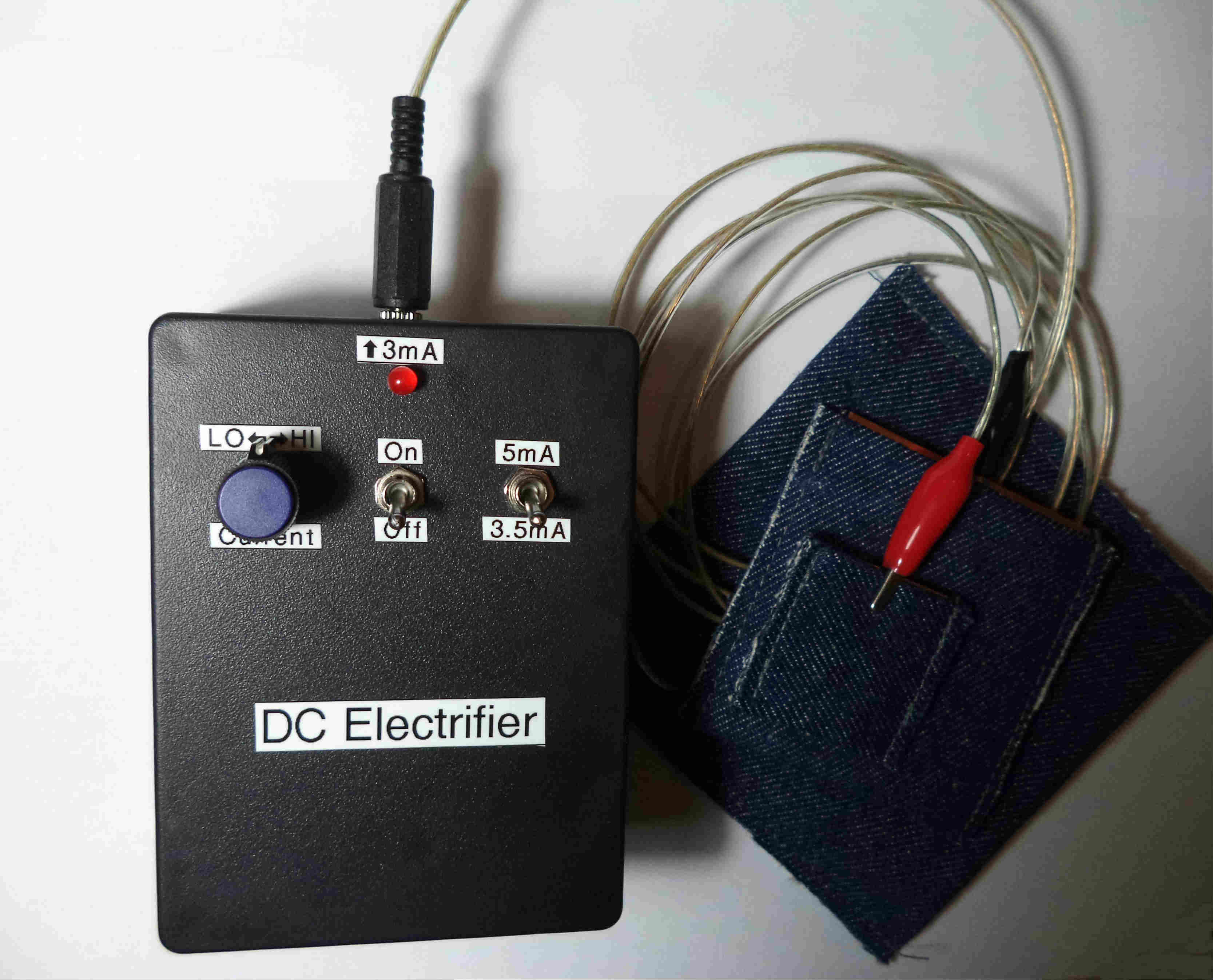
current is normally around.5mA for each square
centimeter of electrode surface. (The maximum electrical current of the
Eliminator is only.06mA/cm2 which is 1/8th
of .5mA/cm2.) The systems of Iontopheresis
have been approved and in use for more than 20 years.
Introduction of Ions Into The
Body Using Direct Electrical Current.
http://www.mhhe.com/hper/physed/athletictraining/powerpoint/chappower/Chap%206-%20Iontophoresis.ppt
A Painless, Sterile, Noninvasive Technique
Demonstrated To Have A Positive Effect On The Healing Process.
Increase intensity slowly until patient reports tingling or prickly
sensation. If pain or a burning sensation occur then the
intensity is too great and should be decreased.
When terminating treatment intensity should be slowly decreased to zero
before electrodes are disconnected.
Patient should be comfortable with no reported or visible signs of pain
or burning.
Check skin every 3-5 minutes looking for signs of skin irritation.
Decrease intensity during treatment to accommodate decrease in skin
impedance to avoid pain or burning.
To ensure maximum contact of electrodes skin should be shaved and
cleaned prior to attachment of the electrodes.
Do not excessively abrade skin during cleaning since damaged skin has
lowered resistance to current and a burn might occur more easily.
Negative ions accumulating at the positive pole or anode produce an
acidic reaction through the formation of hydrochloric acid and produce
softening of the tissues by decreasing protein density which is useful
in treating scars or adhesions.
Positive ions that accumulate at the negative pole produce an alkaline
reaction with the formation of sodium hydroxide and Produce hardening
of the tissues by increasing protein density.
Selecting the Appropriate Ion:
- for Inflammation (positive voltage electrode as "active")
- for Scar Tissue (positive voltage)
+ for Spasm (negative voltage)
+ for Analgesia (pain-killing) (negative voltage)
+ for Edema (negative voltage)
+ for Open Skin Lesions (negative voltage)
|