|
So then I wanted to see how my idea of how premix affects atomization fits into this. Mineral oil atomizes the most, synthetic and castor both atomize the least, and semi-synthetic is between them. Since atomization relies both on premix oil and carb size then we get this graphic which shows their connection. Group 2 with an average sized carb atomizes the fuel the same as a small carb with semi-synthetic oil. 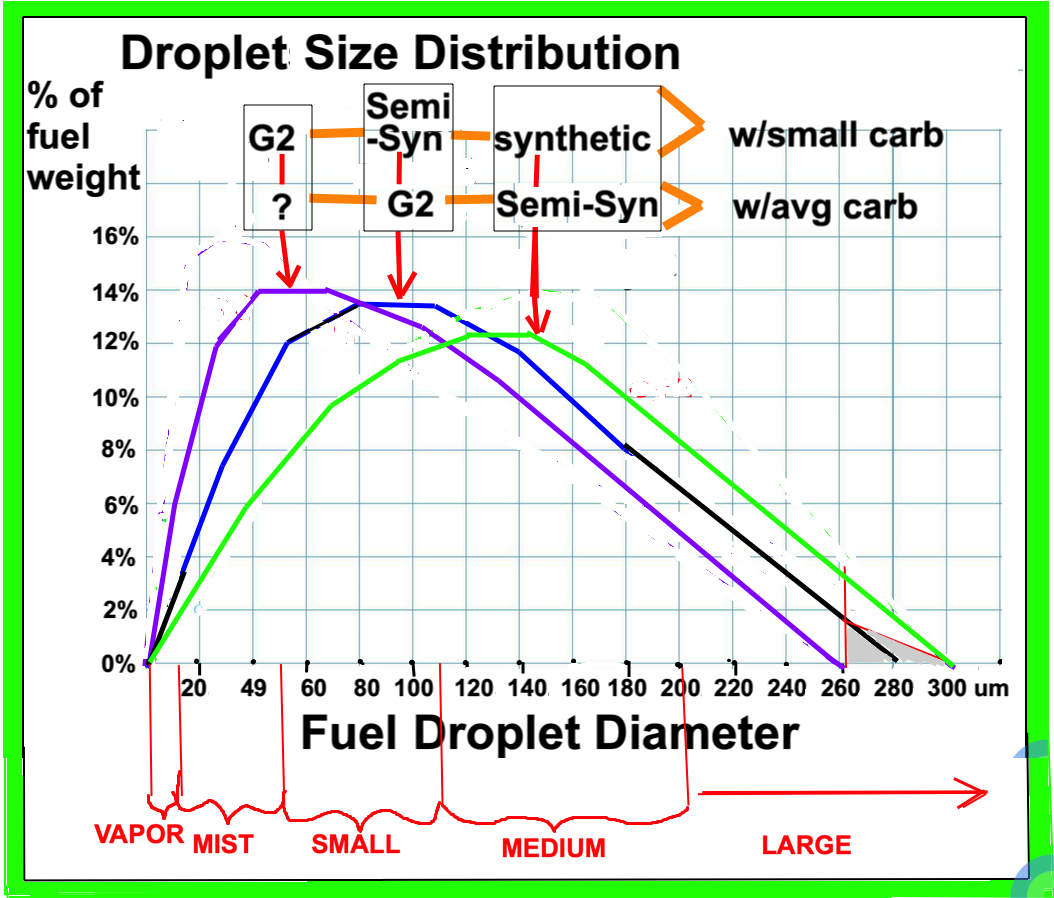 Castor I'm leaving out castor oil now because it's not a commonly used oil, and my uphill tests with it showed it hardly cared what timing it was given, like it's truly "timing independent". I'm also excluding G1/G2 oil blends like Yamalube because I don't know if the G1 oil increases atomization more than G2. Gemini AI said that G1 should have about the same effect as G2 but that premixes with very much solvent should atomize more than those with little solvent. So the question mark on the graph above could be "mineral oil w/solvent" like PJ1 Goldfire Pro, Yamalube 2R, and Bel-Ray SL-2. These should work good in bikes with over-sized carbs (like 125cc w/38mm). So now we need to understand why my engine w/VM18 prefers G2 on flat roads, but semi-synthetic on uphills. The Answer is Two-Fold: 1) On uphills and during hard acceleration we open the throttle fully and then hope the RPM catches up. Until it does the jetting is lean because the main jet is sized for correct fuel flow at top RPM, not this lower RPM. So until the RPM catches up then the lower resulting air speed in the carb causes less vacuum at the needle jet and pulls up less gas. Both "too lean" and "too rich" jetting wants more timing advance. So during this lean condition the engine prefers a more dense premix oil to reduce fuel atomization which allows more large fuel droplets to remain which is somewhat of an imitation of being jetted richer. 2) When more "grunt" is required from the engine then a longer burn due to more large fuel droplets is needed. The more the crank angle is past TDC, the more leverage the conrod has on the crank wheels due to the angle getting closer to 90 degrees. This is also the reason why enduro bikes need more squish ratio (the % of piston top covered by the squish band) than motocross bikes. A wider squish band shields more air/fuel from early combustion. 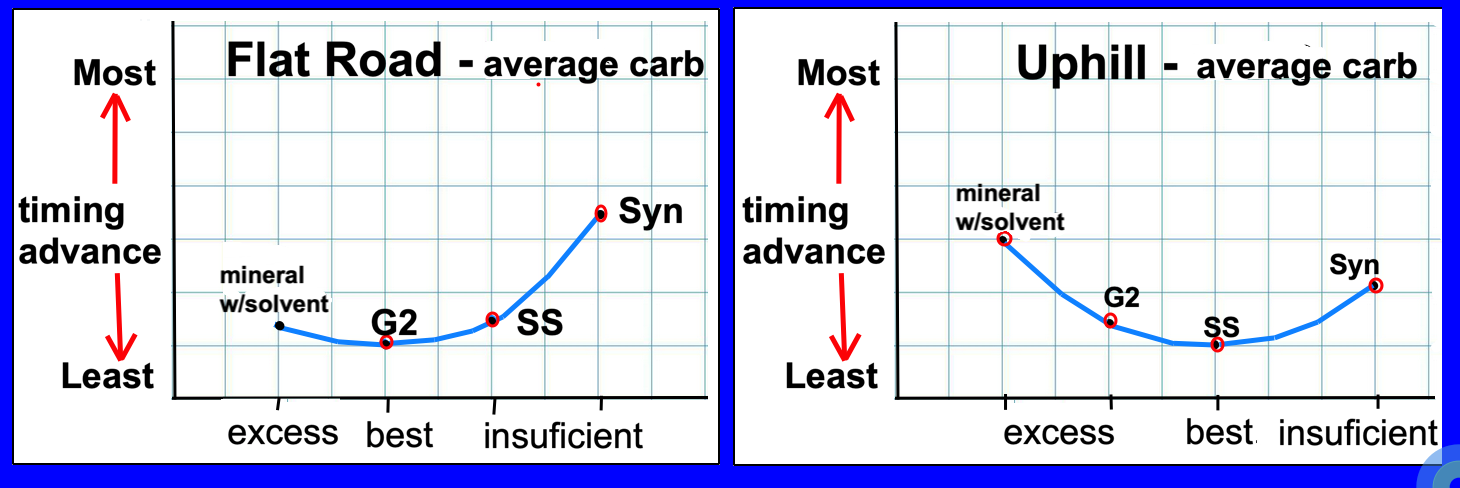 Best Atomization Notice how "best atomization" needs timing closest to TDC. That tells me it gives the quickest burn. Any other atomization other than what is best for the engine will require more timing advance. SYNTHETIC It's great for engine cleanliness and long ring life but for all but undersized carbs it causes insuficient atomization and power loss. But for most motocrossers that doesn't matter because very few riders are athletic enough to fully use the power of a 125cc or 250cc. For them some power loss doesn't matter. What they should do is reduce the amount of synthetic oil they add to gas until they stop getting excess spooge. For most bikes the right ratio with synthetic is 50/1. But that's only for fully synthetic oils. Most that claim to be synthetic are a blend of synthetic and mineral oil. Here's a list of fully synthetic oils: Maxima Super M, Bel-Ray H1-R, Silkolene Comp 2 Plus, Silkolene Pro 2, Maxima FORMULA K-2 (7.5% mineral oil), Castrol Power1 XR 77, Motul 800 2T Off Road and Road Racing (6% mineral oil), Klotz R-50 Techniplate, Honda Pro Honda HP2, Motul Kart Grand Prix, ELF HTX 976+, Repsol Moto Racing 2T Knowing Which Type Oil Is Best For You You should just order my carb/reed valve spreadsheet calculator for Excel or Libre Office (a free download). It shows you 3 carb sizes for your setup and what oil type is best for each one. 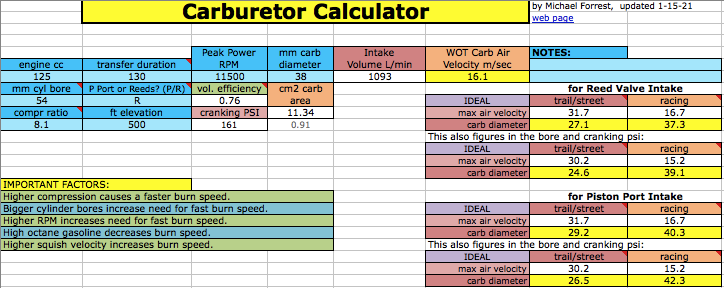 |